 Cardsplain
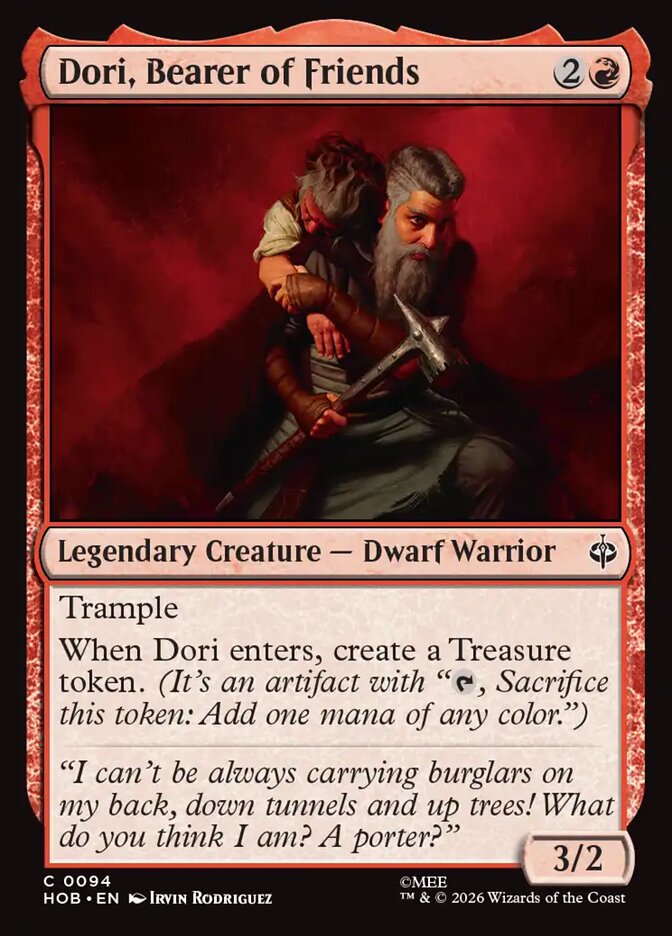
What "" means. Some cards say Legendary on the type line. Dori, Bearer of Friends, for example, is a legendary Dwarf Warrior creature. A lot of this set's characters are legendary: Bilbo, Gollum, Thorin and most of the named Dwarves, Smaug, Gandalf, Bard, and even some like Orcrist and Sting.
The . If you control two or more legendary with the same name, you choose one to keep and put the others into your . This happens right away, as soon as the second one is on the battlefield.
Three details beginners get wrong:
- Same name only. Gollum, Silent Slinker and Gollum, Riddle Master are different cards with different names, so you can have both. The same goes for Bilbo, Luckwearer and Bilbo Baggins, Burglar, or Thorin Oakenshield and Thorin, Mountain-king.
- Per player. Your Dori and your opponent's Dori don't affect each other. The rule only looks at what each player controls.
- The second copy still enters before you choose. It enters the battlefield, its "when this enters" ability triggers, and then you put one of the two into the graveyard. So a second Dori still gives you its , but you spent a whole card and three mana on one Treasure.
Why a second copy is worth much less. While your first copy is alive, the second one is stuck in your hand. It only becomes useful once the first one . A second copy of a normal creature is another creature on the battlefield. So, when you already have one copy of a legendary card:
- Take the second copy over filler, as a backup for when the first one dies.
- Don't take it over or a good creature in your colors.
- A third copy is worth even less.
Win rates miss this. A card's win rate counts every game where it was drawn, so it doesn't show what a second copy adds while the first is on the battlefield. A pick order based only on win rate would take a second Bilbo, Luckwearer over a removal spell that kills any creature.