Cardsplain
On this page

Draw Two is the second most drafted deck (56.4% over 58,594 games), level with Dwarves & Equipment (56.5% over 52,797 games) and about a point behind the top deck, Goblin Army (57.6% over 85,459 games). Its strength is in commons that each draw a card, so even an average pile with no rares is rarely bad. Most cards' win rates run about a point higher in this deck than overall. So a card whose win rate is lower in Draw Two than overall (Kíli the Resourceful, Velvetwing Butterflies) is weak here, and a card that does far better here than in other blue decks (Lakeshore Apothecary, Master's Councillors) belongs to this deck.

Deck win rate 56.4% +0.2 vs average 58,594 games

Compared with the set average (56.2%). Win rates from 17Lands.

How a game goes

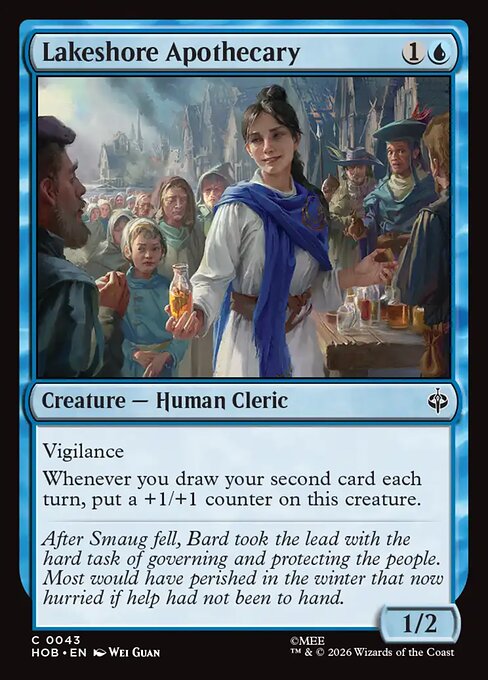
Lakeshore Apothecary grows each time a card or Plunder the Trollshaws draws your second card of a turn.

  1. Early turns

    Turns 1–3: a that cashes in extra draws (Lakeshore Apothecary grows, Master's Councillors ) or Bilbo, Luckwearer, then a 3-drop that draws as it enters (Patient Instructor, Bilbo Baggins, Burglar) or Great Gilded Boat. From turn 3 on, try to draw a second card on every one of your turns, because each time you do, Apothecary, Bard the Bowman and Councillors trigger. Many of your early creatures have , so they can attack and still block.

  2. Middle turns

    Turns 4–6: Long Lake Nuisance and Celebrate the Mountain-king add a or plus a . Attack in the air and with unblockable Bilbo, Luckwearer. Keep Magnificent End and Uneasy Partings for the opponent's attack, because both cost less then. End is cheaper against a creature, and attackers are usually tapped. Partings is cheaper against an attacking nontoken creature. Bard the Bowman's counters and let your small creatures win damage races.

  3. Late game

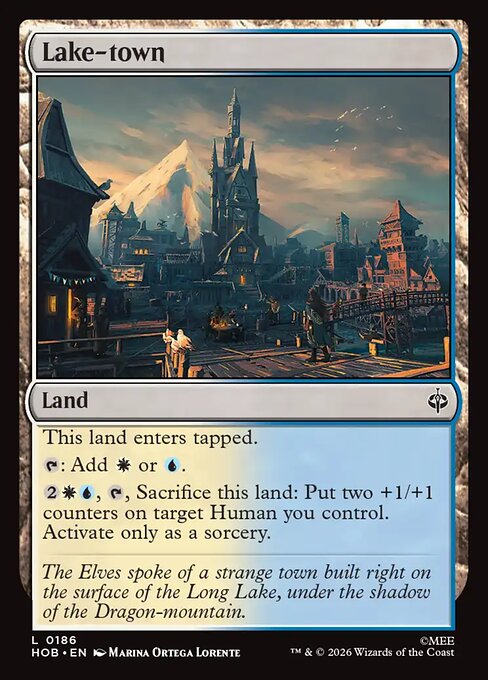
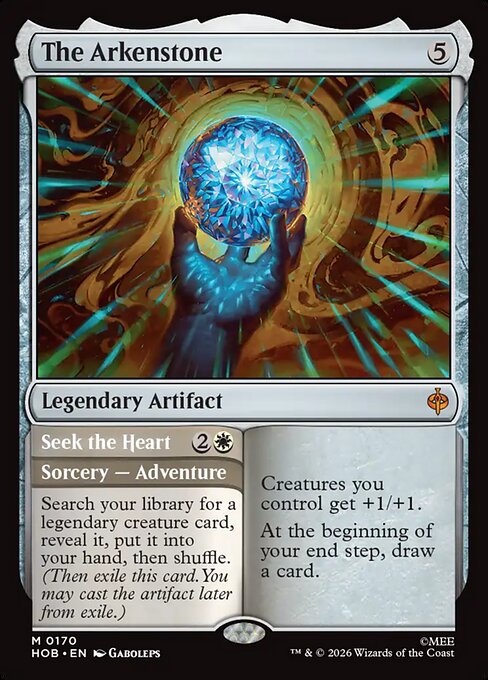
    Turn 7+: you should have more cards than the opponent. back Plunder the Trollshaws (draw two), bring Eagle's Rescue back from the onto a 1-power creature, the Lake-town land to put two +1/+1 counters on a Human, and keep attacking in the air. If the ground is stalled, win with and a wide board of Soldiers pumped by a card that gives all your other creatures +1/+1 (Bard's Company, The Arkenstone).

Second card each turn

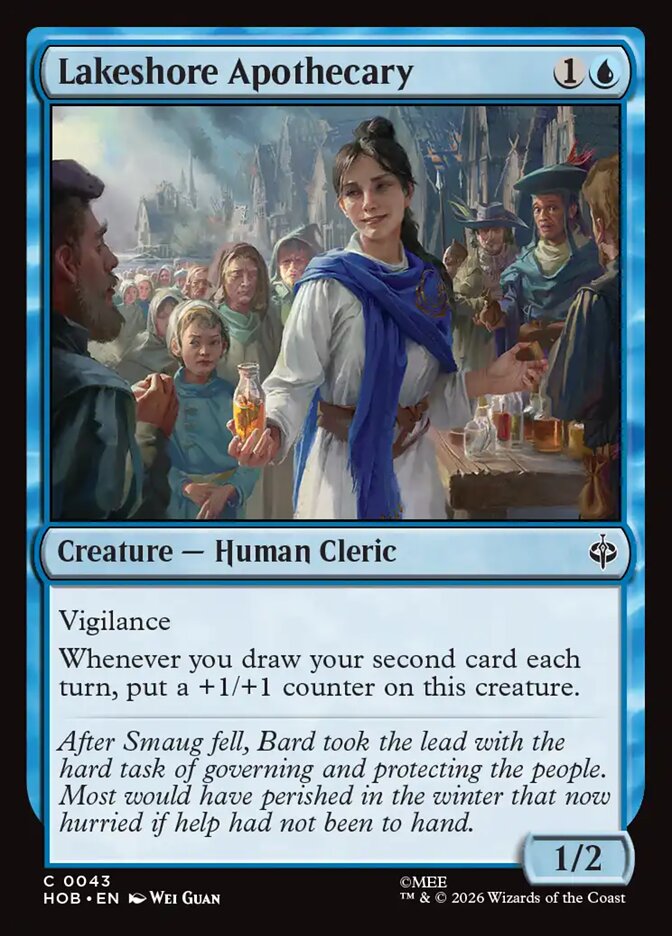
The deck is built around one line printed on several cards, "Whenever you draw your second card each turn" (Lakeshore Apothecary, Bard the Bowman, Master's Councillors). On your own turn the card from your draw step is card one, so the first extra card you draw that turn is card two and triggers all of them. It happens once per turn, so a third or fourth draw adds nothing.

Text box of Lakeshore Apothecary
Lakeshore Apothecary prints the second-card line and gets a when it triggers.

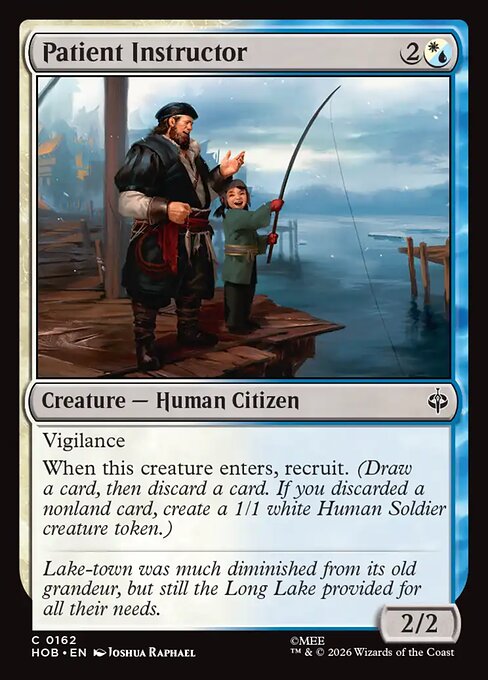
The cheapest extra draw is . You draw a card, then discard a card, and if the discarded card wasn't a land, you also get a 1/1 white Human Soldier . Because the token is a Human, it lets you cast Bard's Company with , and the Lake-town land can put its on it. Example: turn 2 Lakeshore Apothecary. On turn 3 you draw for the turn, then cast Patient Instructor. Its recruit is your second card, so Apothecary gets a +1/+1 counter , and if you discard a spell such as Plunder the Trollshaws you also get a Soldier. Other ways to draw on your own turn are Plunder the Trollshaws, Great Gilded Boat when you attack, and chapter I of The Mountain-king's Return. Bilbo Baggins, Burglar draws when it enters, and Bilbo, Luckwearer when it hits a player.

On the opponent's turn you count from zero. A single draw (Plunder from your hand, the recruit from Bard's Company cast with flash) is only card one and triggers nothing. Drawing two does. Plunder cast from the with draws two cards, and the second one triggers.

Step 1 of 4. You control Lakeshore Apothecary (1/2 vigilance): “Whenever you draw your second card each turn, put a +1/+1 counter on this creature.” Your turn starts and you draw normally. That's card #1 this turn. You have priority.

Your turn, first main phase.
Opponent 20 life
  • No permanents
You 20 life has
  • 1/2
Your hand

Key cards

  • Patient Instructor

    Patient Instructor

    common Creature — Human Citizen

    Sets up the plan

    Why it works

    A pre-release review rated it 2 out of 10. It is the deck's most important common, because its on turn 3 is the usual way to draw card two early, and the Soldier it can make is a Human for Bard's Company. The cost is hybrid (), so the last mana can be white or blue and either of your colors casts it.

    How to play it and the numbers

    How to play it

    Cast it in your main phase before combat, so your payoffs trigger before you attack. Lakeshore Apothecary on turn 2 and this on turn 3 is the start the deck wants.

    Patient Instructor just looks bad to me, but I hope I'm valuing the incorrectly somehow, because I do want it to be good.

    Win rates

    Win rate when drawn () in Draw Two decks
    59.7% +1.4 vs all decks 33,069 games
    Win rate when drawn () in all decks
    58.3% 55,365 games

    Win rates from 17Lands.

    Replacements

    If you don't see Patient Instructor, these do the same job: sets up the plan.
    Win rates from .

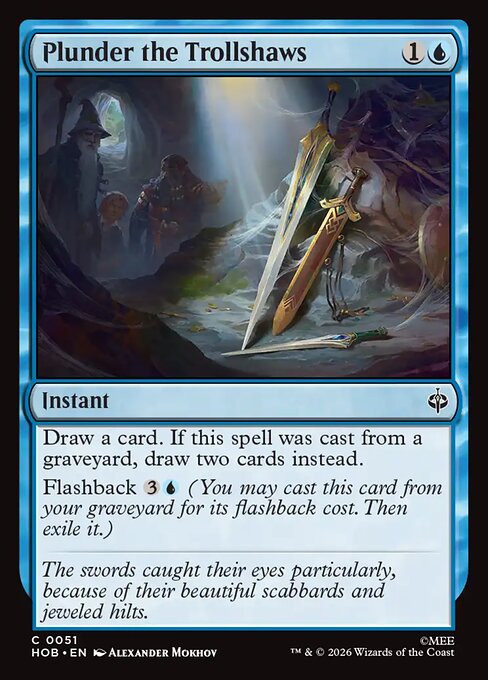
  • Plunder the Trollshaws

    Plunder the Trollshaws

    common Instant

    Gets you extra cards

    Why it works

    This 2-mana draws one card, and lets you cast it again from your for 4 mana to draw two, then exiles it. On your turn the single draw is card two, and the flashback's two draws trigger your payoffs on either player's turn. Removal Control (55.8%) and Elf Landfall (54.6%) get much less from it, so take it early only for Draw Two.

    How to play it and the numbers

    How to play it

    From your hand, cast it in your main phase after the draw step so it counts as card two. it back at the end of the opponent's turn when you have 4 spare mana, and its second card still triggers Bard the Bowman and Apothecary.

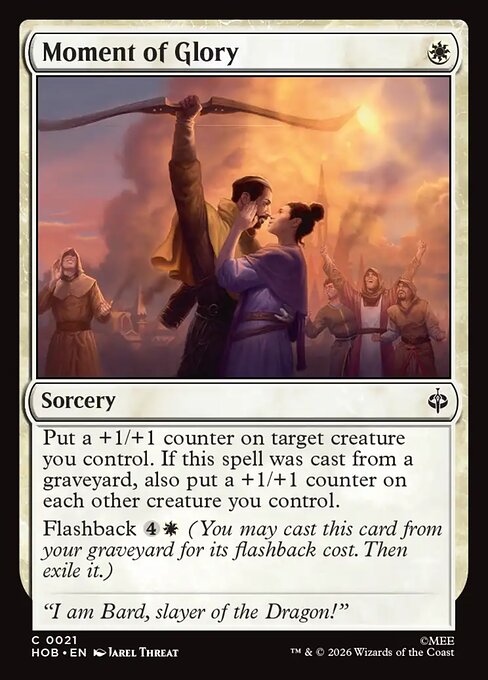
    The money shot to discard is Plunder the Trollshaws, which is miles better than either Moment of Glory or Eagle's Rescue.

    Win rates

    Win rate when drawn () in Draw Two decks
    60.3% +1.8 vs all decks 31,400 games
    Win rate when drawn () in all decks
    58.5% 50,977 games

    Win rates from 17Lands.

    Replacements

    If you don't see Plunder the Trollshaws, these do the same job: gets you extra cards.

    Win rates from .

  • Lakeshore Apothecary

    Lakeshore Apothecary

    common Creature — Human Cleric

    Rewards the plan

    Why it works

    From turn 3, you draw a second card most turns, and each one puts a +1/+1 counter on this 2-mana 1/2, so by turn 5 it can be a 4/5.

    How to play it and the numbers

    How to play it

    Turn 2 is its slot, so it starts growing on turn 3. Make each extra draw before combat and it attacks one size bigger.

    I'm not a fan of that aren't good enough until you put some work in.

    Win rates

    Win rate when drawn () in Draw Two decks
    58.7% +1.7 vs all decks 35,695 games
    Win rate when drawn () in all decks
    57.0% 52,839 games

    Win rates from 17Lands.

    Replacements

    If you don't see Lakeshore Apothecary, these do the same job: rewards the plan.

    Win rates from .

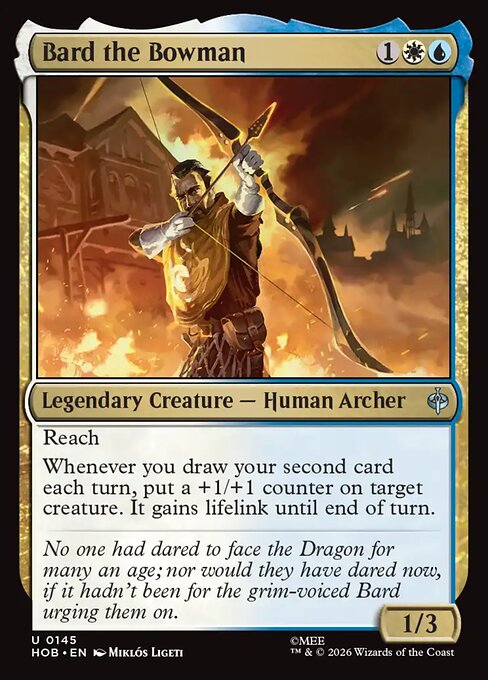
  • Bard the Bowman

    Bard the Bowman

    uncommon Legendary Creature — Human Archer

    Rewards the plan

    Why it works

    This deck's gold uncommon puts a +1/+1 counter on target creature whenever you draw your second card each turn, and that creature gains until end of turn. Each extra draw grows one creature for good, and the 1/3 body with holds off early .

    How to play it and the numbers

    How to play it

    Time the second draw. One before combat (Patient Instructor, Plunder) puts the counter and on an attacker, and Plunder's on their turn gives a blocker lifelink. Counters belong on creatures that keep connecting, such as and Bilbo, Luckwearer.

    Win rates

    Win rate when drawn () in Draw Two decks
    59.5% +0.7 vs all decks 21,420 games
    Win rate when drawn () in all decks
    58.8% 24,682 games

    Win rates from 17Lands.

    Replacements

    If you don't see Bard the Bowman, these do the same job: rewards the plan.

    Win rates from .

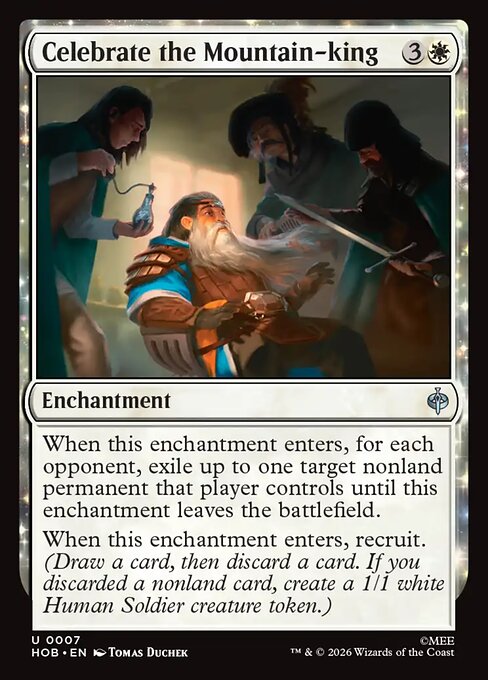
  • Celebrate the Mountain-king

    Celebrate the Mountain-king

    uncommon Enchantment

    Removal

    Why it works

    Any nonland an opponent controls is a legal target, and included, and it stays until Celebrate leaves the battlefield. The comes in your main phase, usually as your second card of the turn, so the also feeds your payoffs.

    How to play it and the numbers

    How to play it

    Spend it on the biggest threat already on the battlefield instead of waiting for a better one. If they destroy Celebrate (Thorin's Last Stand can hit an ), their card comes back. An stops existing, so exiling a big token is .

    White also has four banger uncommons, one of which is the best in the entire set (Celebrate the Mountain-king).

    Win rates

    Win rate when drawn () in Draw Two decks
    63.8% +1.6 vs all decks 15,515 games
    Win rate when drawn () in all decks
    62.2% 30,687 games

    Win rates from 17Lands.

    Replacements

    If you don't see Celebrate the Mountain-king, these do the same job: removal.

    Win rates from .

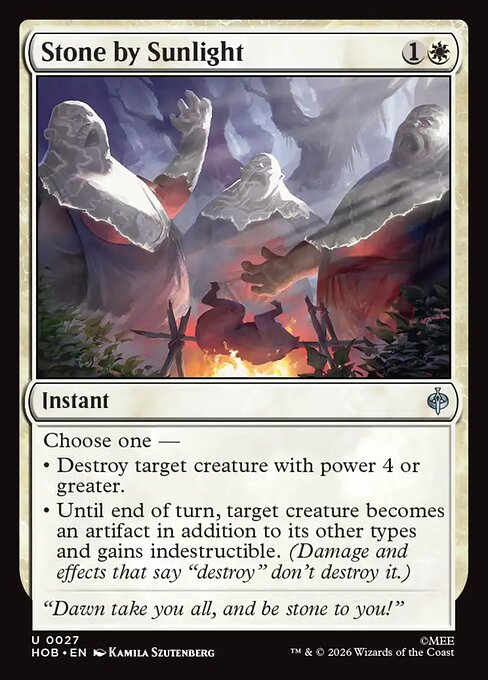
  • Stone by Sunlight

    Stone by Sunlight

    uncommon Instant

    Removal

    Why it works

    One mode destroys a creature with power 4 or greater, the big bodies your small creatures can't block. The other makes a creature an with until end of turn, which saves Bard's Company or Bard the Bowman from damage or a "destroy" spell.

    How to play it and the numbers

    How to play it

    Keep 2 mana open on their turn and pick the mode the turn needs. The kill mode can't touch a creature with 3 power or less, so don't hold it for their . doesn't stop , or shrinking (-X/-X), and as an your creature becomes a target for their artifact .

    Win rates

    Win rate when drawn () in Draw Two decks
    61.3% +1.0 vs all decks 14,343 games
    Win rate when drawn () in all decks
    60.3% 28,322 games

    Win rates from 17Lands.

    Replacements

    If you don't see Stone by Sunlight, these do the same job: removal.

    Win rates from .

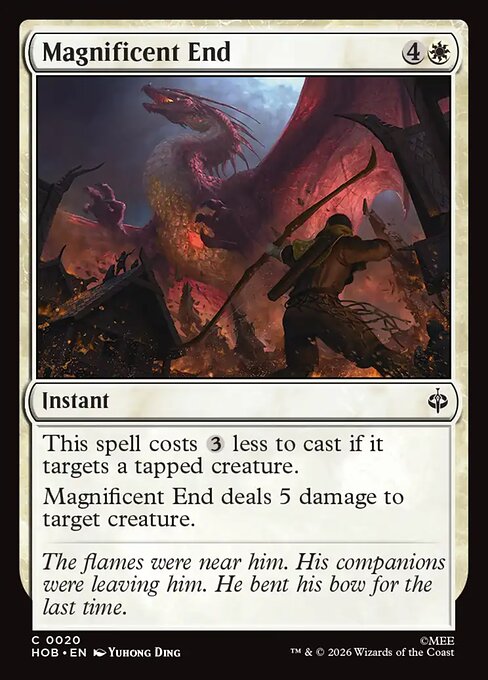
  • Magnificent End

    Magnificent End

    common Instant

    Removal

    Why it works

    Five damage kills almost any creature in the set, and against a one the spell costs only 2. On their turn that fits beside the mana you already hold for Plunder and Stone by Sunlight, and 4 open mana covers both.

    How to play it and the numbers

    How to play it

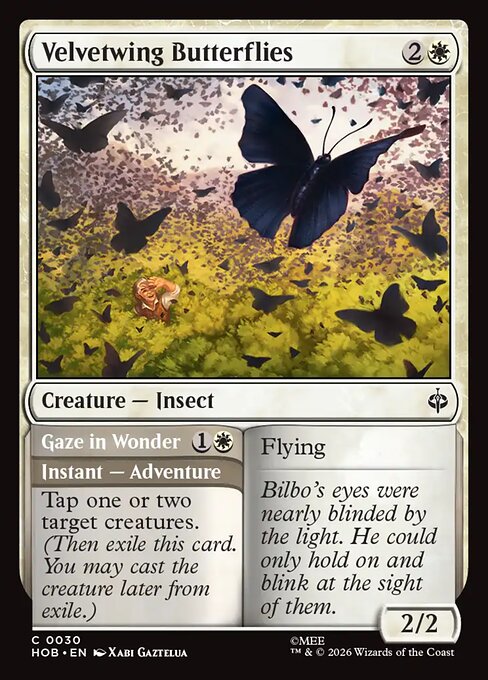
    Kill an attacker after attackers are declared. On your own turn it costs the full 5 unless their creature is , and Gaze in Wonder can tap it. A attacker stays untapped and gets no discount.

    Two mana for 5 damage is a very good rate, even if it only targets a creature.

    Win rates

    Win rate when drawn () in Draw Two decks
    57.9% +1.1 vs all decks 23,446 games
    Win rate when drawn () in all decks
    56.8% 46,144 games

    Win rates from 17Lands.

    Replacements

    If you don't see Magnificent End, these do the same job: removal.

    Win rates from .

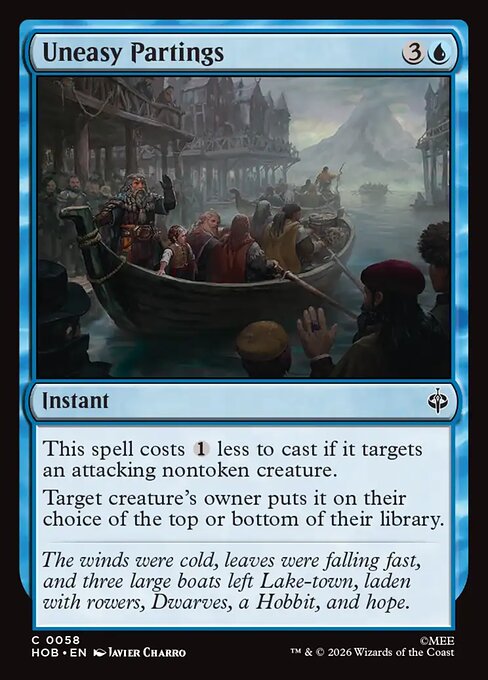
  • Uneasy Partings

    Uneasy Partings

    common Instant

    Removal

    Why it works

    The owner chooses the top or bottom of their library and usually picks the top, so the spell costs them their next draw and the mana to cast the creature again. Against a it is full , because a token put into a library stops existing.

    How to play it and the numbers

    How to play it

    Aim it at an attacker they spent a lot on, best of all one carrying an or . They lose the Aura, and the Equipment has to be equipped again. Against a you pay the full 4.

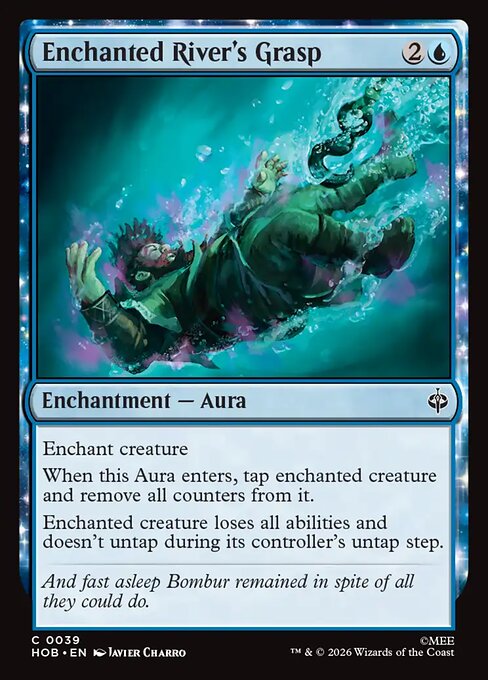
    Its spells (Uneasy Partings, Enchanted River's Grasp) aren't too bad, but it tends to play best when another color is providing cheap, reliable removal.

    Win rates

    Win rate when drawn () in Draw Two decks
    57.8% +1.6 vs all decks 22,082 games
    Win rate when drawn () in all decks
    56.2% 38,308 games

    Win rates from 17Lands.

    Replacements

    If you don't see Uneasy Partings, these do the same job: removal.

    Win rates from .

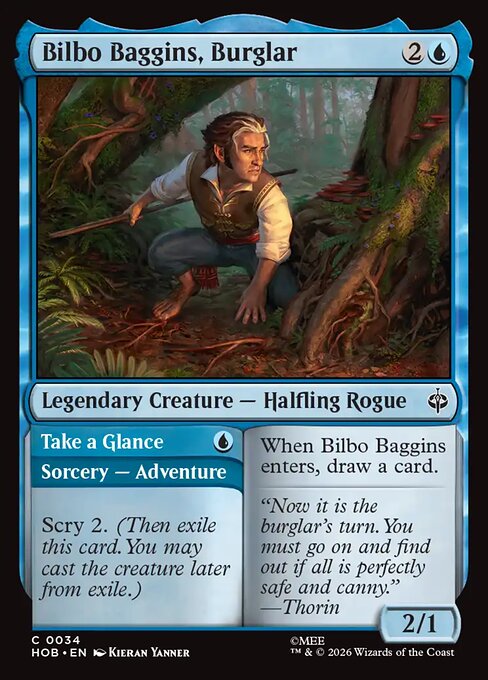
  • Bilbo Baggins, Burglar // Take a Glance

    Bilbo Baggins, Burglar // Take a Glance

    common Legendary Creature — Halfling Rogue // Sorcery — Adventure

    Gets you extra cards

    Why it works

    A that draws a card as it enters is at common, and Take a Glance, its 1-mana , scries 2. A second copy still draws as it enters, even though you keep only one of the two.

    How to play it and the numbers

    How to play it

    With 4 mana, cast Take a Glance and then Bilbo the same turn, so you 2 and draw the card you kept on top. Bilbo alone is the turn-3 play.

    You basically always want to cast both halves of this on the same turn unless you're really desperate.

    Win rates

    Win rate when drawn () in Draw Two decks
    59.2% +1.7 vs all decks 30,172 games
    Win rate when drawn () in all decks
    57.5% 51,284 games

    Win rates from 17Lands.

    Replacements

    If you don't see Bilbo Baggins, Burglar, these do the same job: gets you extra cards.

    Win rates from .

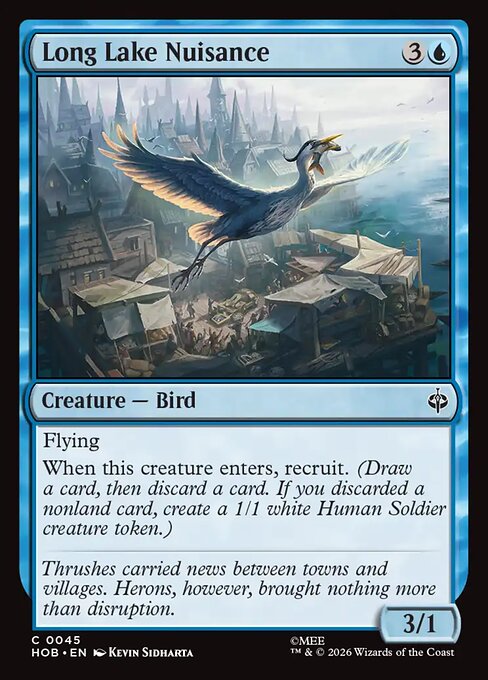
  • Long Lake Nuisance

    Long Lake Nuisance

    common Creature — Bird

    Threat

    Why it works

    Four mana buys a 3/1 , a and often a 1/1 Soldier. The weak point is its 1 toughness, which any 1/1 flier or damage spell can punish.

    How to play it and the numbers

    How to play it

    Attack whenever the air is clear, and keep it out of ground blocks. Bard the Bowman's +1/+1 counters cover its 1 toughness.

    One toughness makes this creature so vulnerable to and other 1/1 that it just won't be good enough a lot of the time.

    Win rates

    Win rate when drawn () in Draw Two decks
    58.9% +1.2 vs all decks 32,246 games
    Win rate when drawn () in all decks
    57.7% 49,140 games

    Win rates from 17Lands.

    Replacements

    If you don't see Long Lake Nuisance, these do the same job: threat.

    Win rates from .

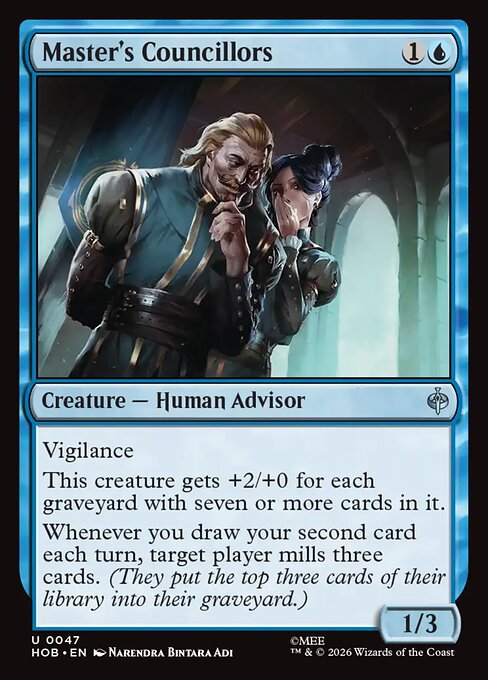
  • Master's Councillors

    Master's Councillors

    uncommon Creature — Human Advisor

    Rewards the plan

    Why it works

    A target player three whenever you draw your second card each turn, and this deck does that most turns. Once graveyards fill up it attacks for 3 or 5 instead of 1, since it gets +2/+0 for each with seven or more cards.

    How to play it and the numbers

    How to play it

    Point the at the opponent. Their reaches seven sooner, and a deck that draws as much as yours can run out of cards in a long game if it mills itself. discards fill your own graveyard anyway. Its 3 toughness holds off most early attackers.

    One thing you might not notice immediately is that this can be a 5/3 with , because it counts each .

    Win rates

    Win rate when drawn () in Draw Two decks
    59.6% +1.5 vs all decks 18,855 games
    Win rate when drawn () in all decks
    58.1% 28,347 games

    Win rates from 17Lands.

    Replacements

    If you don't see Master's Councillors, these do the same job: rewards the plan.

    Win rates from .

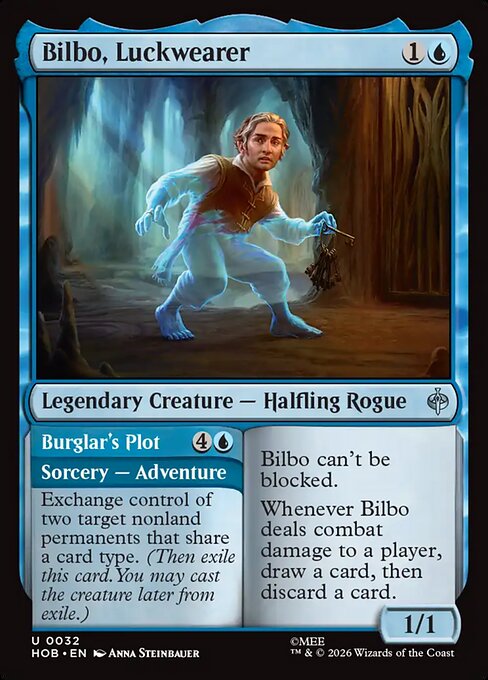
  • Bilbo, Luckwearer // Burglar's Plot

    Bilbo, Luckwearer // Burglar's Plot

    uncommon Legendary Creature — Halfling Rogue // Sorcery — Adventure

    Sets up the plan

    Why it works

    Nothing can block it, and each time it deals combat damage to a player you draw a card and discard a card (a ). Every hit is an extra draw after your draw step, so from turn 3 it triggers your second-card payoffs each turn it connects. Burglar's Plot, the 5-mana , swaps one of your nonland for one of theirs that shares a card type, such as your 1/1 Soldier for their best creature.

    How to play it and the numbers

    How to play it

    Get it down on turn 2 and attack every turn after that. The comes with combat damage, so a counter from Bard the Bowman lands after the damage and helps in later fights. Against a , cast Burglar's Plot first and the 1/1 afterwards.

    It's even better in base blue decks though, since a turn-2 looter is incredible for setting up Lakeshore Apothecary and Bard the Bowman.

    Win rates

    Win rate when drawn () in Draw Two decks
    62.5% +2.2 vs all decks 17,384 games
    Win rate when drawn () in all decks
    60.3% 29,559 games

    Win rates from 17Lands.

    Replacements

    If you don't see Bilbo, Luckwearer, these do the same job: sets up the plan.
    Win rates from .
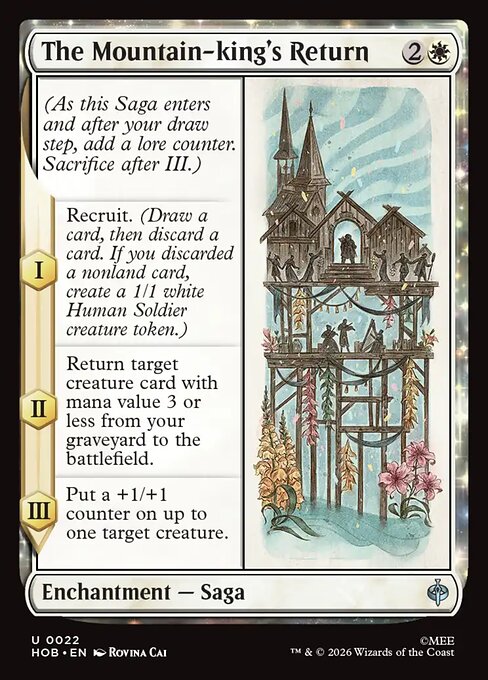
  • The Mountain-king's Return

    The Mountain-king's Return

    uncommon Enchantment — Saga

    Gets you extra cards

    Why it works

    Discard a to chapter I's and you get the Soldier now and the creature back next turn, since chapter II returns a creature card with 3 or less from your to the battlefield. Chapter III adds a +1/+1 counter to up to one creature.

    How to play it and the numbers

    How to play it

    Chapter I happens as the enters, so cast it after your draw step and its is card two. Patient Instructor and Bilbo Baggins, Burglar are the discards to aim for, because each one's enter ability gives you card two again when chapter II brings it back. With no good discard, chapter II can still return a creature that in combat.

    The fact that you can use the ability from the first chapter to discard the creature you want to reanimate with the second makes this a very neat little design.

    Win rates

    Win rate when drawn () in Draw Two decks
    62.4% +1.3 vs all decks 16,352 games
    Win rate when drawn () in all decks
    61.1% 29,924 games

    Win rates from 17Lands.

    Replacements

    If you don't see The Mountain-king's Return, these do the same job: gets you extra cards.

    Win rates from .

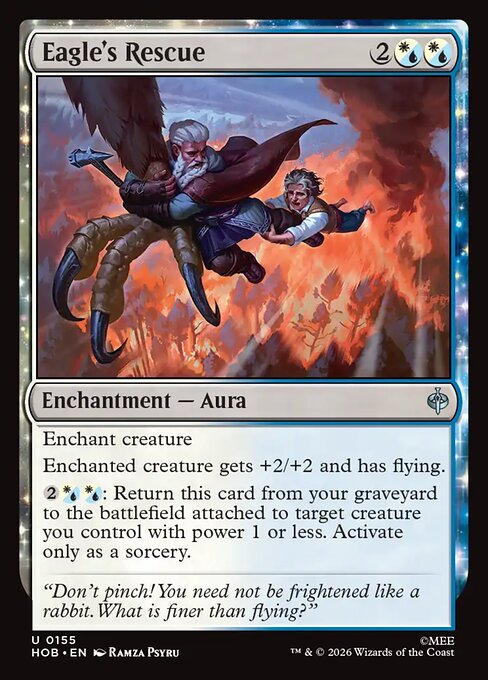
  • Eagle's Rescue

    Eagle's Rescue

    uncommon Enchantment — Aura

    Threat

    Why it works

    A deck full of 1-power creatures gets an that keeps coming back. For 4 mana it gives +2/+2 and , and for the same 4 mana, as a , it returns from your attached to a creature you control with power 1 or less. Soldier , a fresh Lakeshore Apothecary, Bard the Bowman, Bilbo, Luckwearer and Iron Hills Blacksmith all qualify.

    How to play it and the numbers

    How to play it

    Put it on a creature that will keep attacking, and when that creature , bring the back later. Watch the power check. An Apothecary with one counter has power 2 and can no longer take it from the .

    Then, when your opponent does kill it, you can keep bringing it back to buff your small creatures, almost as though it were a powerful equipment still on the battlefield.

    Win rates

    Win rate when drawn () in Draw Two decks
    58.5% +1.9 vs all decks 10,335 games
    Win rate when drawn () in all decks
    56.6% 14,793 games

    Win rates from 17Lands.

    Replacements

    If you don't see Eagle's Rescue, these do the same job: threat.

    Win rates from .

  • Bard's Company

    Bard's Company

    rare Creature — Human Citizen

    Rewards the plan

    Why it works

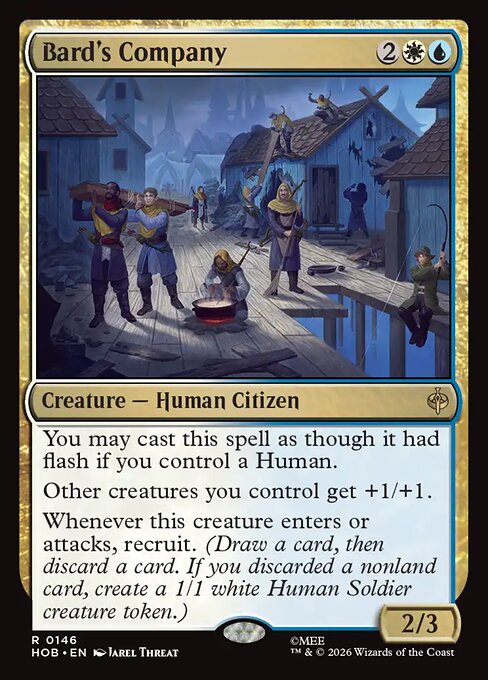
    Your Soldier and most of your creatures are Humans, so you can nearly always cast it with . Every other creature you control gets +1/+1, and it recruits as it enters and again each time it attacks. Take it over any common or uncommon.

    How to play it and the numbers

    How to play it

    The strongest moment is the opponent's combat, after attackers are declared and before blocks, when every blocker gets +1/+1 and you . If combat offers nothing, it in at their end step and attack on your turn for a second recruit before blocks. in mid-combat takes the +1/+1 away, so against open mana make only blocks that work without the bonus.

    Be careful of getting your Bard's Company removed in the middle of combat (or of your WU opponent having it).

    Win rates

    Win rate when drawn () in Draw Two decks
    65.5% +1.4 vs all decks 8,732 games
    Win rate when drawn () in all decks
    64.1% 11,705 games

    Win rates from 17Lands.

    Replacements

    If you don't see Bard's Company, these do the same job: rewards the plan.

    Win rates from .
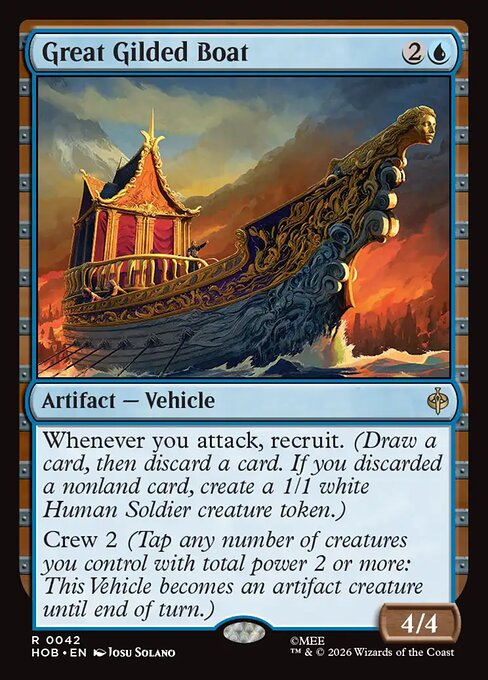
  • Great Gilded Boat

    Great Gilded Boat

    rare Artifact — Vehicle

    Gets you extra cards

    Why it works

    Attacking with anything recruits, even while the Boat stays home. That happens as you attack, before blockers, so on a turn with no other extra draw it is your second card and Bard the Bowman's counter lands in time for the fight.

    How to play it and the numbers

    How to play it

    Attack every turn you safely can, even with one creature such as Bilbo, Luckwearer or a . Crew 2 ( creatures with total power 2 or more) only when the Boat has a good attack of its own, because the crew can't block afterwards. Once you fall behind and can't attack, it does nothing, so it is strongest cast on turn 3, before blockers pile up.

    Try to attack as much as possible if you see this card.

    Win rates

    Win rate when drawn () in Draw Two decks
    63.3% +1.7 vs all decks 6,471 games
    Win rate when drawn () in all decks
    61.6% 11,603 games

    Win rates from 17Lands.

    Replacements

    If you don't see Great Gilded Boat, these do the same job: gets you extra cards.

    Win rates from .
How to tell it's open

The deck runs on commons that other drafters undervalue. Patient Instructor, Plunder the Trollshaws, Long Lake Nuisance, Bilbo Baggins, Burglar and Lakeshore Apothecary are taken around picks 6–8 on average, so seeing them mid-pack is normal. Seeing several still there at picks 9–10 says blue is open. The uncommons are the stronger signal. Celebrate the Mountain-king and Stone by Sunlight are usually gone by pick 3 or 4 and Bard the Bowman by pick 5, so one arriving later than that says white or Draw Two is flowing. Elf Landfall (52.5% over 22,251 games) and Removal Control (53.2% over 12,745 games) are weaker blue decks and Burn and Draw (55.2% over 4,886 games) is rarely drafted, so a blue drafter next to you is usually also heading for Draw Two. If the blue commons dry up in pack 2, the player passing to you in that pack is in blue too. White is shared with Dwarves & Equipment, which fights you for Magnificent End and Celebrate.

Common mistakes

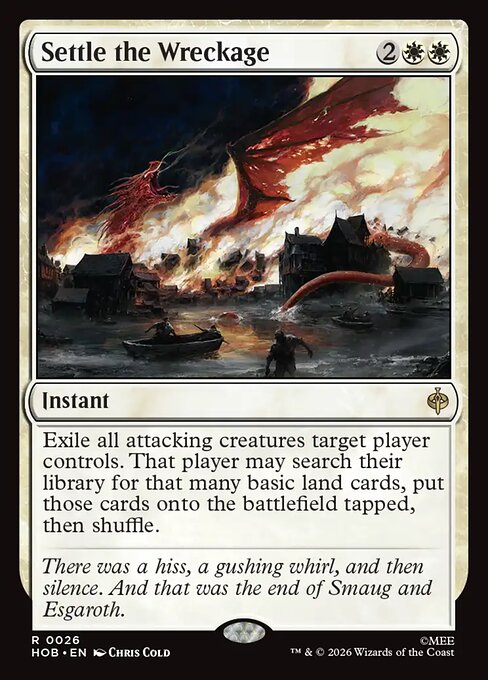
  • Drawing on the wrong turn. Payoffs trigger on your second card of a turn, and on the opponent's turn you start counting from zero. Plunder the Trollshaws cast from your hand at their end step is only your first card on their turn and triggers nothing. Cast it in your own main phase after your draw step instead. Hold it for their turn only when you want the mana open anyway (Settle the Wreckage, Stone by Sunlight).

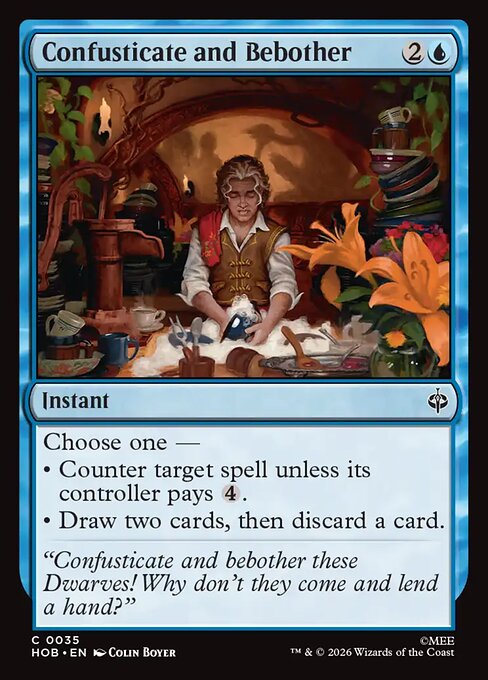
  • Too many draw spells, too few creatures. Drawing does nothing without bodies to grow and attack with. Aim for 15 or more creatures. Soldier from are a bonus and don't count toward that number. In pack 3, take the creature over Confusticate and Bebother or Sound the Trumpets.

  • Discarding the wrong card to . Only a nonland discard makes the 1/1 Soldier, so early on discard a spell you can still use from the : Plunder the Trollshaws () or Eagle's Rescue (it returns itself). Discard a land once you have enough lands to cast everything in your hand, and accept that you get no .

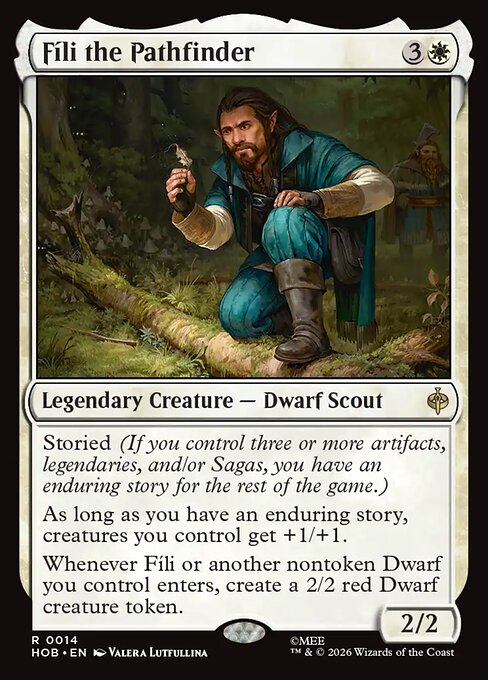
  • Ignoring the . Bard the Bowman, The Queen of Dale, Fíli the Pathfinder, Bilbo, Luckwearer and many other cards here are . Two with the same name can't stay on the battlefield, so a second copy is worth much less than a different good card. The three Bilbos have different names and can all be out together: Bilbo, Luckwearer; Bilbo, Thief in the Night; and Bilbo Baggins, Burglar.

  • Taking the clunky because the deck likes flying. Ravenhill Flock, Eagle of the Great Shelf and The Lord of the Eagles all have low win rates here. The flying cards that do well also draw (Long Lake Nuisance) or come back from the (Eagle's Rescue).

Better or worse in this deck