Cardsplain
On this page

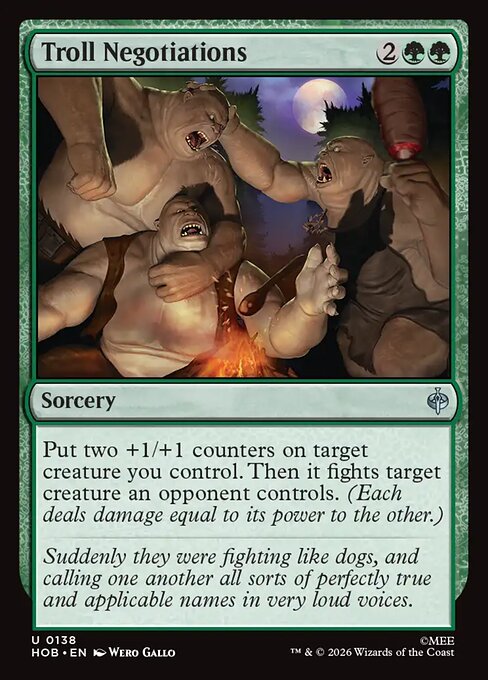
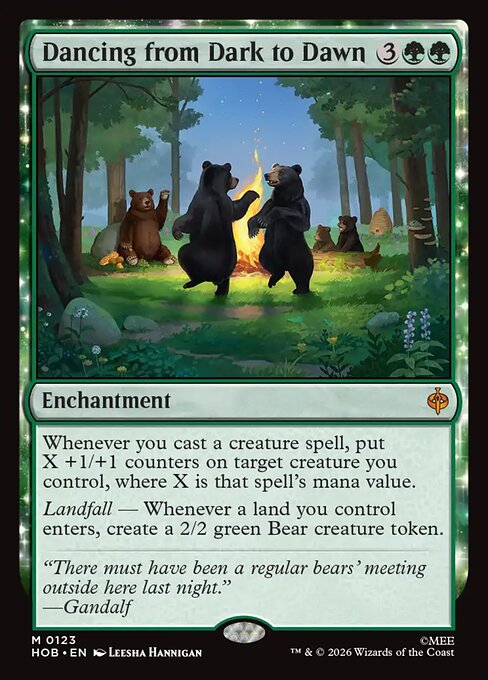
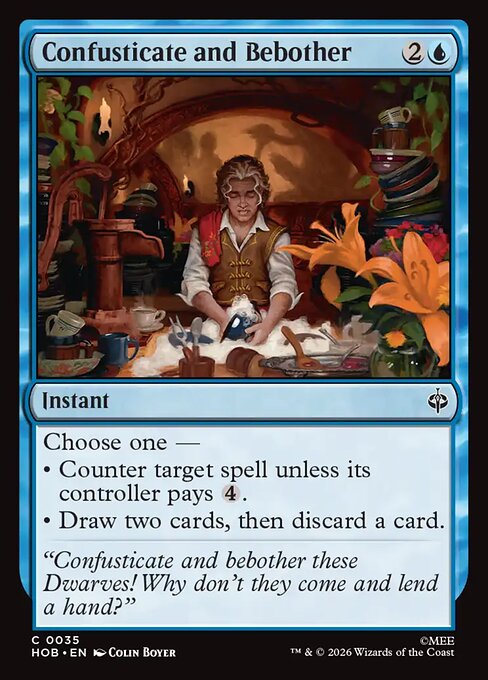
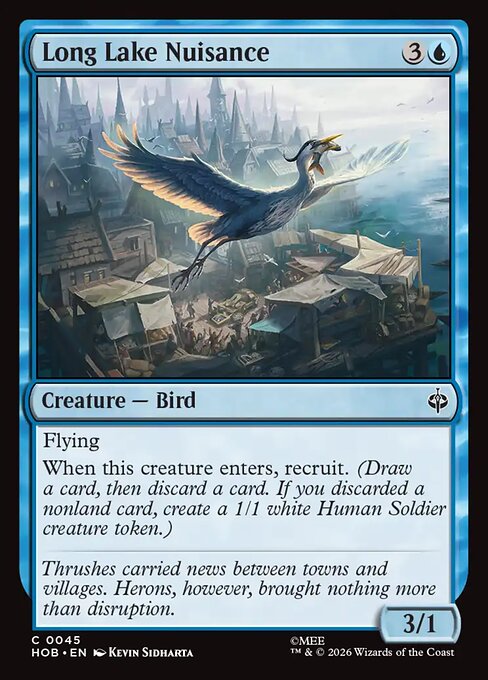
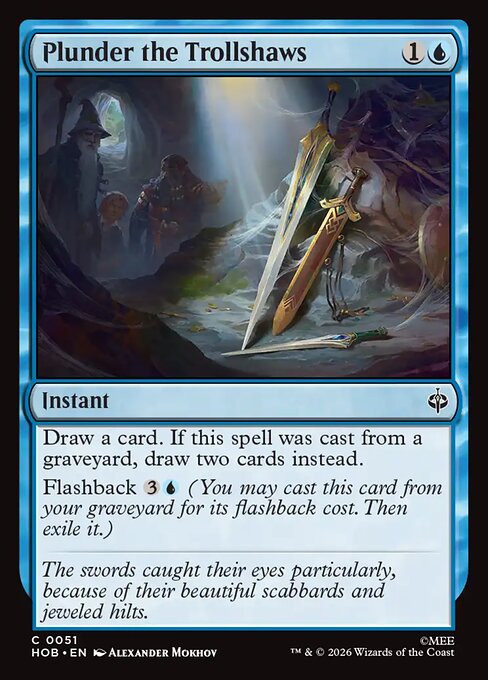
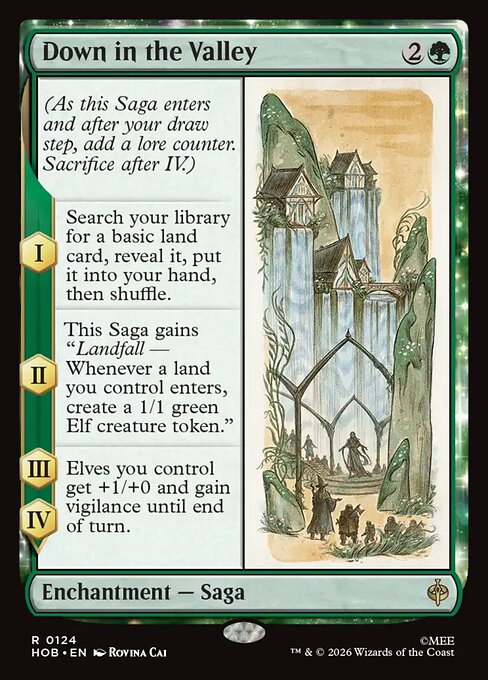
It wins 52.5% over 22,251 games, the weakest of the five decks people draft most, against 56.4% over 58,594 games for Draw Two and 56.9% over 57,277 games for Ferocious Wolves, the two decks it shares a color with. It has good cards, but its two halves don't help each other. Blue's commons do well in fast decks (Draw Two, Burn and Draw) and fall off next to green. Plunder the Trollshaws is 60.3% in Draw Two but 54.6% here, and Long Lake Nuisance is 58.9% against 54.2%. Green brings only conditional (Quarrel and Troll Negotiations need a big creature of yours), and the deck has almost no , so games stall on the ground while the other deck's evasive creatures and kill spells win. End up here when Thranduil, Sindarin Liege comes to you along with the other rares and uncommons (Thranduil's Company at 63.1%, Dancing from Dark to Dawn, Down in the Valley). Draft it as a green landfall deck that takes blue cards for removal and evasion.

Deck win rate 52.5% −3.7 vs average 22,251 games

Compared with the set average (56.2%). Win rates from 17Lands.

How a game goes

With Thranduil, Sindarin Liege on the battlefield, each land you play makes an Elf that Thranduil turns into a 2/2. With Thranduil's Company, each land also puts two +1/+1 counters on one of your creatures.

  1. Early turns

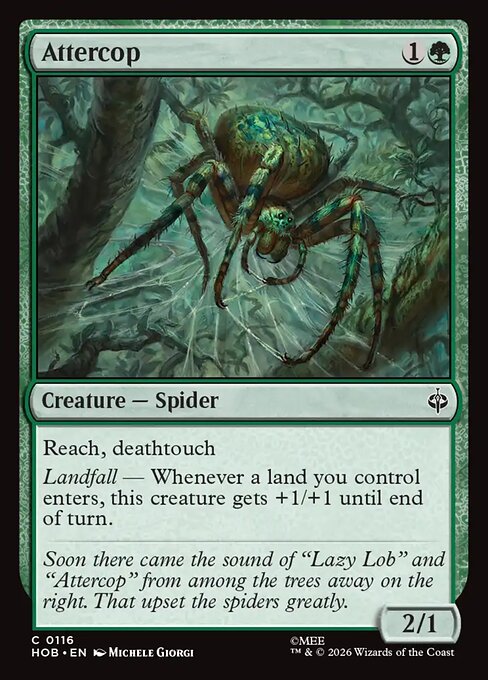
    Turns 1–3: your is Attercop to block or Woodland Weavemaster for extra mana early, then Mirkwood Pathmaker or Wood Elves on turn 3. With Weavemaster out, a turn-3 Thranduil or Thranduil's Company is the strongest start. You are usually the slower deck, so don't race.

  2. Middle turns

    Turns 4–6: cast Thranduil, Thranduil's Company or Down in the Valley, so each land you play after that pays off. Play lands before combat, keep a Hobbit Hole uncracked for a surprise trigger, and spend your few spells on and the creatures your ground army can't get past.

  3. Late game

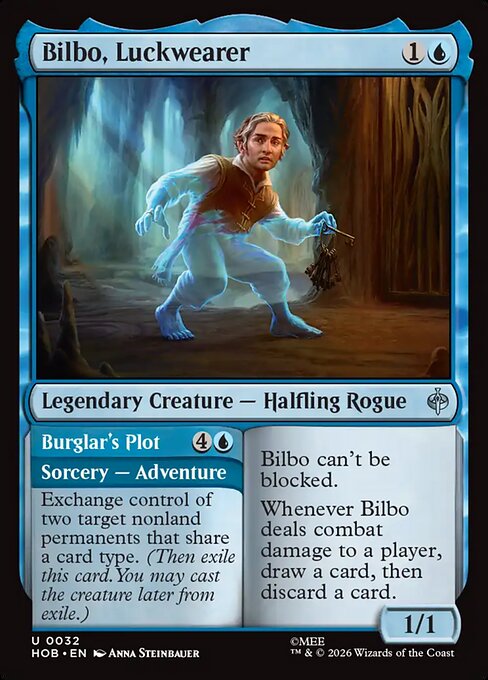
    Turn 7+: Mirkwood Pathmaker is a 7/7 or bigger and your board is wider than theirs. Win by attacking with everything once the counters and outgrow their blockers, with Bilbo, Luckwearer or a Long Lake Nuisance getting damage past a stalled board. Keep a spare creature back against Crude Bent Blade.

Landfall

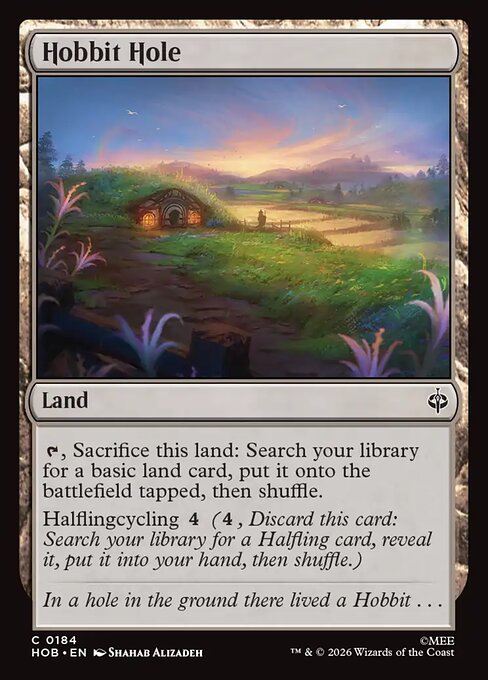
triggers every time a land enters the battlefield under your control. Your normal land drop counts, and so does a land a card puts onto the battlefield: Wood Elves puts a Forest from your library onto the battlefield, and sacrificing Hobbit Hole puts a basic land onto the battlefield . So Hobbit Hole gives two triggers, one when you play it and one when you crack it (tap and it for the basic land), and you choose when the second one happens, even on the opponent's turn or in the middle of combat.

Example: with Thranduil, Sindarin Liege out, playing a land creates a 1/1 Elf , which is a 2/2 because Thranduil gives your other Elves +1/+1. Casting Wood Elves then makes a second token from its Forest. With Thranduil's Company out, each land puts two +1/+1 counters on a creature you control. With both out, each land does both.

The deck's second theme is Elves. Thranduil's Company gives its extra land drop only while you control another Elf, and Woodland Weavemaster's mana can only pay for Elf spells and Elves' abilities.

Key cards

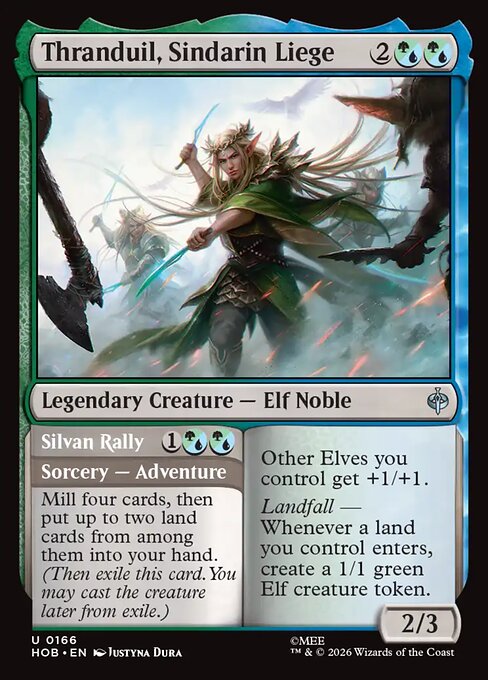
  • Thranduil, Sindarin Liege // Silvan Rally

    Thranduil, Sindarin Liege // Silvan Rally

    uncommon Legendary Creature — Elf Noble // Sorcery — Adventure

    Rewards the plan

    Why it works

    The deck is built around this 4-mana 2/3 uncommon. Besides the Elf , his +1/+1 reaches Mirkwood Pathmaker, Wood Elves and Thranduil's Company, and it lets Woodland Weavemaster for 2. The symbols are hybrid mana, paid with either green or blue, so any mix of Forests and Islands casts him.

    How to play it and the numbers

    How to play it

    Silvan Rally, his 3-mana , four and puts up to two lands from among them into your hand, so cast it on turn 3 when your hand is short on lands. The card then waits in , and you cast Thranduil from there on turn 4 or 5. When you can pay for him without this turn's land, cast him first and play the land after, for a right away.

    Win rates

    Win rate when drawn () in Elf Landfall decks
    58.7% +0.4 vs all decks 6,332 games
    Win rate when drawn () in all decks
    58.3% 19,439 games

    Win rates from 17Lands.

    Replacements

    If you don't see Thranduil, Sindarin Liege, these do the same job: rewards the plan.
    Win rates from .

  • Mirkwood Pathmaker

    Mirkwood Pathmaker

    uncommon Creature — Elf Ranger

    Threat

    Why it works

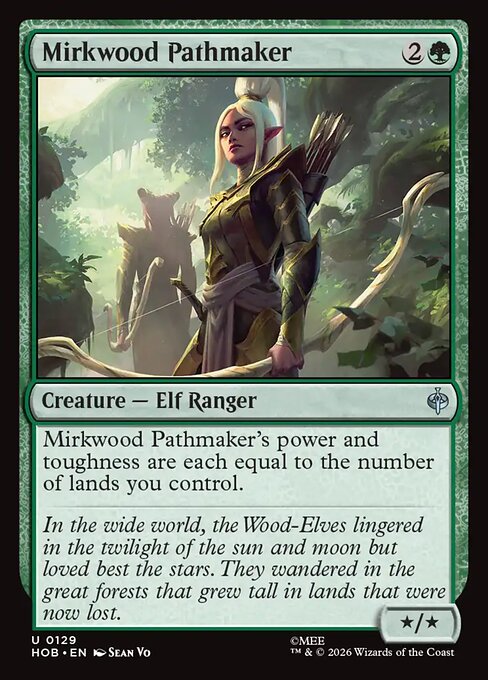
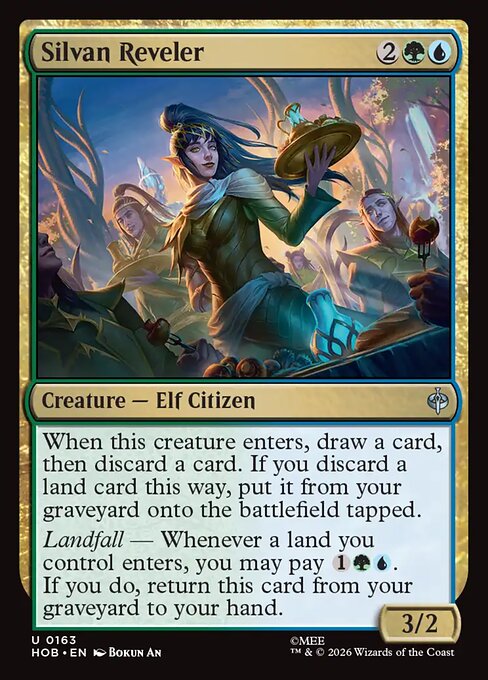
    Power and toughness both equal your land count, so this 3-mana Elf is a 3/3 on turn 3 and a 6/6 or bigger later. The extra lands from Wood Elves and Silvan Reveler grow it ahead of the normal , and it is usually your biggest creature by the time Quarrel or Troll Negotiations needs one.

    How to play it and the numbers

    How to play it

    Turn 3 is its slot, and it stays home until it outgrows their blockers. Once they throw a in front of it every turn, it does more as Quarrel's source, since a 6/6 kills almost anything Quarrel points it at.

    Win rates

    Win rate when drawn () in Elf Landfall decks
    58.7% −0.9 vs all decks 5,494 games
    Win rate when drawn () in all decks
    59.6% 19,147 games

    Win rates from 17Lands.

    Replacements

    If you don't see Mirkwood Pathmaker, these do the same job: threat.

    Win rates from .

  • Quarrel

    Quarrel

    common Instant

    Removal

    Why it works

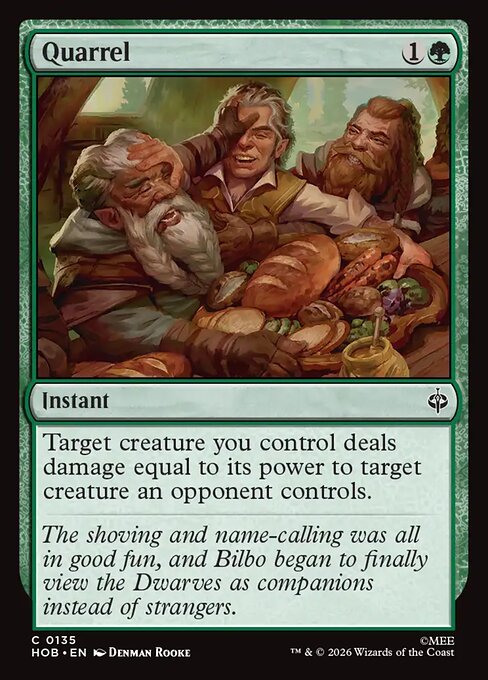
    Quarrel is the deck's best spell. Your creature deals damage equal to its power to theirs and takes none back. This deck's early creatures are small (Wood Elves and Woodland Weavemaster have 1 power), so it is weaker here than in Ferocious Wolves. Make Mirkwood Pathmaker or a creature carrying Thranduil's Company's counters the source, or Attercop, whose makes its 2 damage lethal.

    How to play it and the numbers

    How to play it

    Wait until your creature is safe. If they kill it in response, Quarrel deals no damage and you've lost two cards to their one. They're least able to answer when out, or during your combat once has pumped your creature. While drafting, count your creatures with 3 or more power or so Quarrel always has a source.

    Other in response leaves you on the wrong side of a .

    Win rates

    Win rate when drawn () in Elf Landfall decks
    55.3% −1.7 vs all decks 9,247 games
    Win rate when drawn () in all decks
    57.0% 34,443 games

    Win rates from 17Lands.

    Replacements

    If you don't see Quarrel, these do the same job: removal.

    Win rates from .

  • Thranduil's Company

    Thranduil's Company

    rare Creature — Elf Soldier

    Rewards the plan

    Why it works

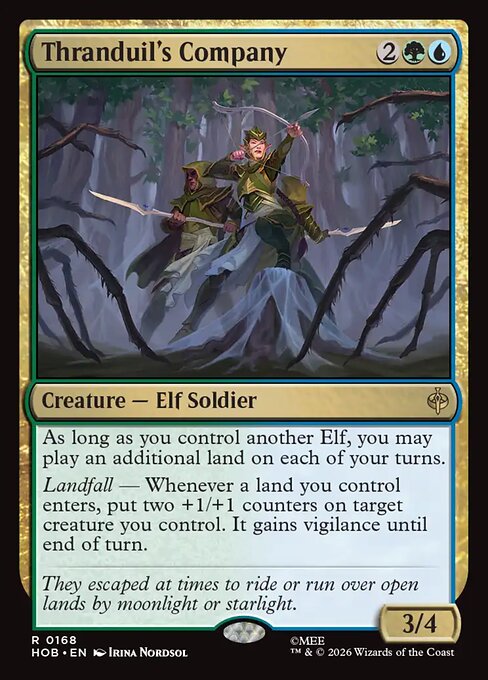
    Every land that enters under your control puts two +1/+1 counters on one of your creatures, so once this 4-mana 3/4 is out, each land drop is a +2/+2 that stays. Count the extra land drop as a bonus, since it needs another Elf and a spare land in hand.

    How to play it and the numbers

    How to play it

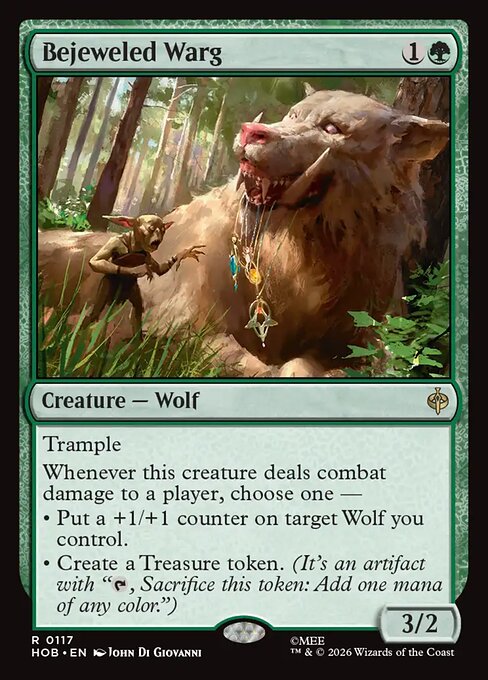
    Take it first in these colors. Its counters do the most on a trampler such as Bejeweled Warg or Large Bear, where a chump blocker no longer soaks up the extra damage. The that comes with each trigger lets the creature you grew attack and still block on their turn.

    My favorite thing to do with Thranduil's Company is just to play a Hobbit Hole and go to attacks, which makes any one of your creatures effectively +2/+2 at will!

    Win rates

    Win rate when drawn () in Elf Landfall decks
    63.1% +1.0 vs all decks 3,470 games
    Win rate when drawn () in all decks
    62.1% 7,550 games

    Win rates from 17Lands.

    Replacements

    If you don't see Thranduil's Company, these do the same job: rewards the plan.
    Win rates from .
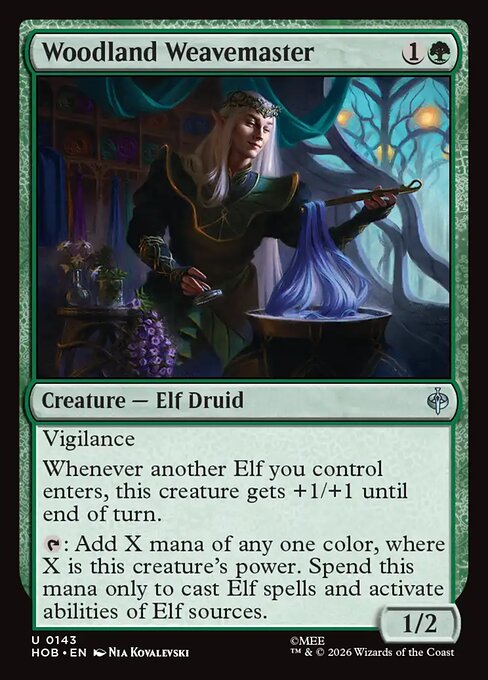
  • Woodland Weavemaster

    Woodland Weavemaster

    uncommon Creature — Elf Druid

    Sets up the plan

    Why it works

    Its mana equals its power and pays only for Elf spells and abilities of Elf sources, and the Elves here include Wood Elves, Mirkwood Pathmaker, Thranduil, Thranduil's Company and Boughside Wanderers. Ferocious Wolves has too few of them and gets only 49.8% from it, so take it only for this deck. The Draftsim guide skipped it, expecting it to need ten or more Elves, but about eight are enough.

    How to play it and the numbers

    How to play it

    On turn 2 it sets up a turn-3 Thranduil or Thranduil's Company, since its 1 mana plus three lands pays for either. lets it attack and still for mana after combat. Another Elf entering gives it +1/+1 until end of turn, so it often taps for 2. , Bilbo and Silvan Rally (an , not an Elf spell) can't use its mana.

    10+ elves I guess for this one? That's probably not where you want to be anyways, so I've yet to actually play Woodland Weavemaster in any of my runs.

    Win rates

    Win rate when drawn () in Elf Landfall decks
    55.3% +1.6 vs all decks 4,955 games
    Win rate when drawn () in all decks
    53.7% 7,392 games

    Win rates from 17Lands.

    Replacements

    If you don't see Woodland Weavemaster, these do the same job: sets up the plan.

    Win rates from .
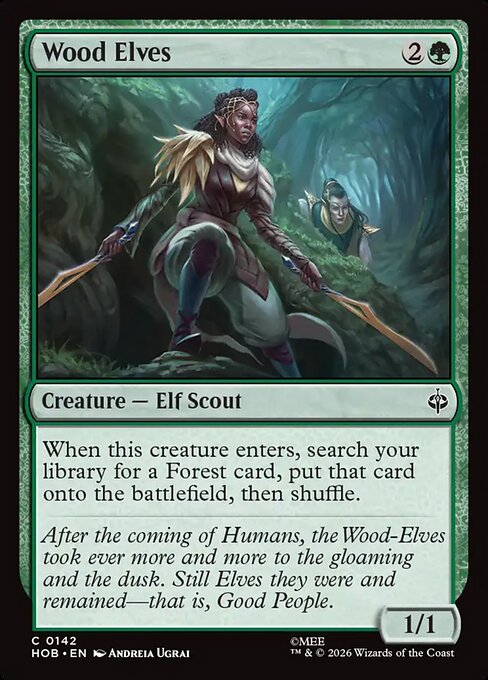
  • Wood Elves

    Wood Elves

    common Creature — Elf Scout

    Sets up the plan

    Why it works

    The Forest it fetches onto the battlefield is an extra trigger, and the 1/1 body is an Elf for Woodland Weavemaster and Thranduil's Company. With Thranduil out, that means a 2/2 plus a 2/2 Elf for 3 mana.

    How to play it and the numbers

    How to play it

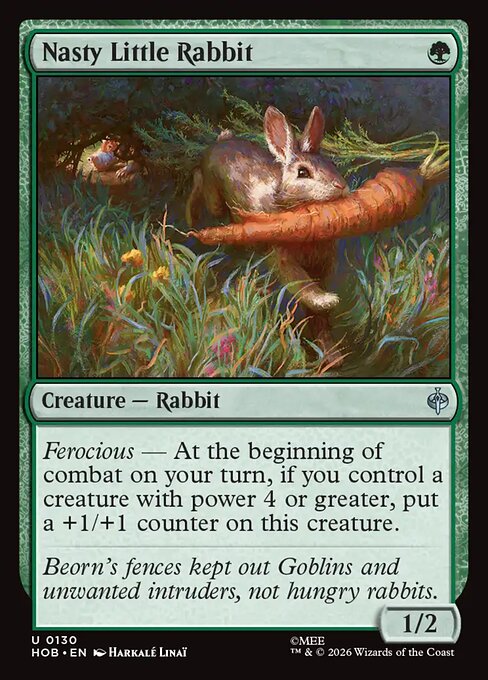
    The Forest enters untapped, so with four lands you can cast Wood Elves and still spend the new Forest on Quarrel or Nasty Little Rabbit. Your blue mana still has to come from your other lands. Later in the game, the 1/1 is a spare body to chump-block with.

    Win rates

    Win rate when drawn () in Elf Landfall decks
    54.3% +0.3 vs all decks 7,336 games
    Win rate when drawn () in all decks
    54.0% 17,064 games

    Win rates from 17Lands.

    Replacements

    If you don't see Wood Elves, these do the same job: sets up the plan.

    Win rates from .
  • Attercop

    Attercop

    common Creature — Spider

    Early play

    Why it works

    and kill whatever this 2/1 blocks or is blocked by, included, which makes it the deck's best common . Deathtouch also applies to Quarrel's damage, so the two together kill any creature.

    How to play it and the numbers

    How to play it

    Keep it home early, where it trades with the biggest creature they attack with. Late in the game it is the best target for Warg Tactics' counter mode, because a creature with needs to assign only 1 damage to its blocker.

    Win rates

    Win rate when drawn () in Elf Landfall decks
    54.7% −1.4 vs all decks 7,345 games
    Win rate when drawn () in all decks
    56.1% 30,096 games

    Win rates from 17Lands.

    Replacements

    If you don't see Attercop, these do the same job: early play.

    Win rates from .
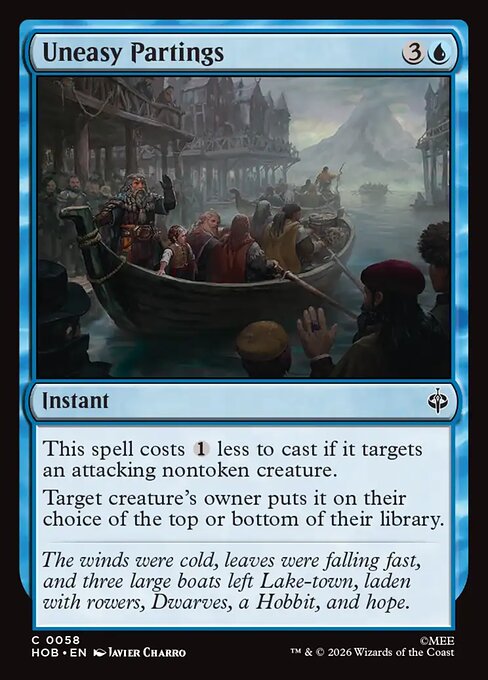
  • Uneasy Partings

    Uneasy Partings

    common Instant

    Removal

    Why it works

    Their creature goes into their library at speed, and since its owner picks top or bottom, they usually redraw it next turn. That buys a turn and the mana they spend to recast it. Counters and on the creature are gone for good, so it hits hardest on a creature they have built up.

    How to play it and the numbers

    How to play it

    Against an attacking nontoken creature it costs 3 instead of 4, so cast it on their turn after attackers are declared. A sent to the library stops existing, so it answers a big token for good, at the full 4 mana. Attack on the turn they spend recasting what you sent back.

    Win rates

    Win rate when drawn () in Elf Landfall decks
    53.6% −2.6 vs all decks 7,049 games
    Win rate when drawn () in all decks
    56.2% 38,308 games

    Win rates from 17Lands.

    Replacements

    If you don't see Uneasy Partings, these do the same job: removal.

    Win rates from .
How to tell it's open

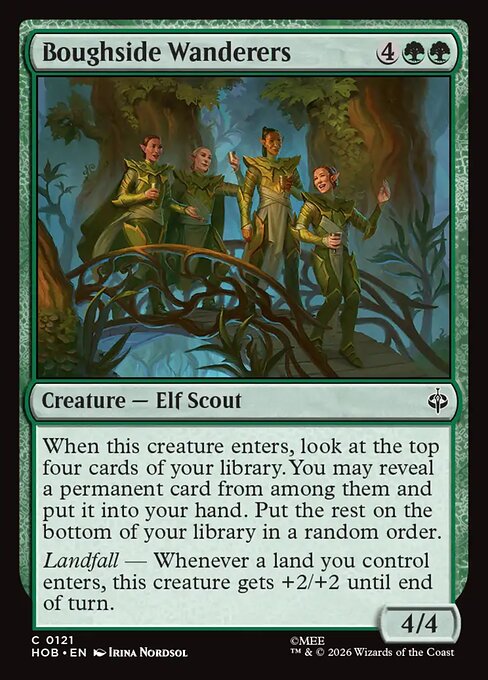
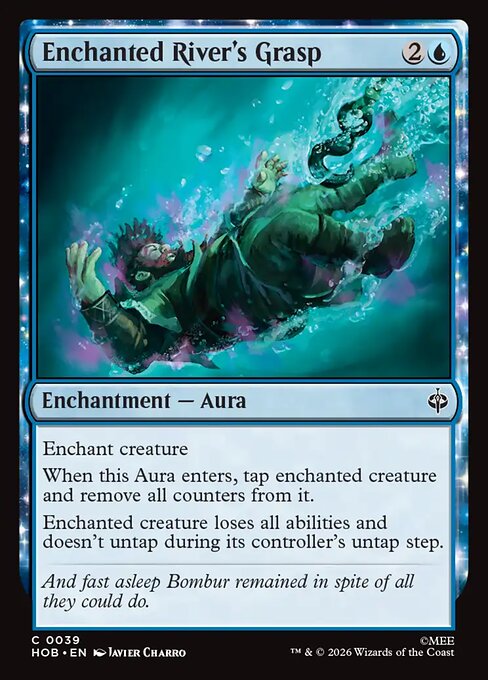
Thranduil, Sindarin Liege and Mirkwood Pathmaker, both uncommons, usually go around pick 4 (average pick 3.8), so seeing either at pick 6 or later in pack 1 says green is open. Ferocious Wolves drafters fight over Quarrel (average pick 6.0), so if it comes at pick 8 or later, nobody near you is in green. Wood Elves (8.7), Woodland Weavemaster (7.8) and Boughside Wanderers (10.3) come late even when the deck is contested, so they tell you little. Pick them up late, but don't move in because of them. For blue, a late Enchanted River's Grasp (average pick 6.7) means the Draw Two drafters aren't next to you.

Common mistakes

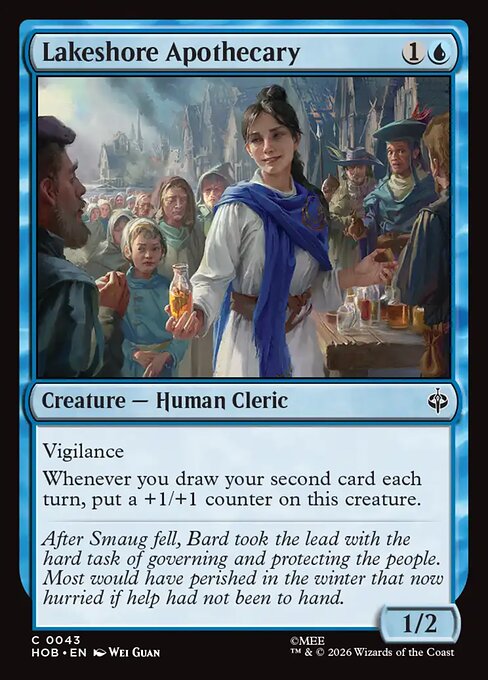
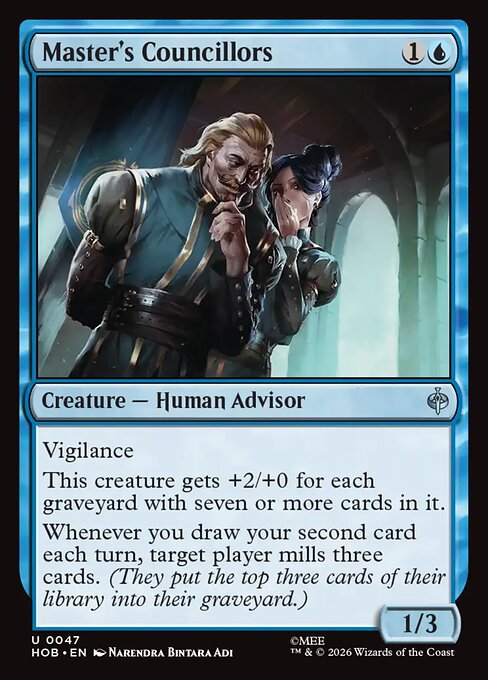
  • Drafting the blue half like Draw Two. Lakeshore Apothecary (52.4% here, 58.7% in Draw Two) and Master's Councillors (52.8% here, 59.6% there) only work when you draw a second card each turn, and a Draw Two deck has twice as many cards that do that, because white's cards come on top of blue's.

  • Expecting blue's to carry the deck. Uneasy Partings (53.6%) and Enchanted River's Grasp (53.4%) do worse here than in Draw Two and sit only a little above the deck average, and these colors have no cheap, unconditional kill spell. Play every removal spell you get, but plan to win with the board. Take Quarrel early, and value the Elf cards (Woodland Weavemaster, Wood Elves, Down in the Valley) at least as highly as the blue removal, because in this deck those cards do as well or better.

  • Playing your land after combat out of habit. bonuses like Attercop's +1/+1 and Boughside Wanderers' +2/+2 last until end of turn, so play the land before you attack. The exception is an uncracked Hobbit Hole or Elven Passage, which you crack after blockers are declared.

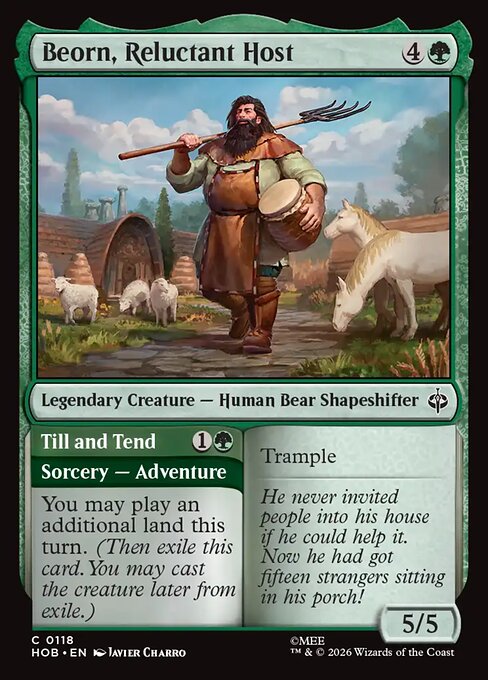
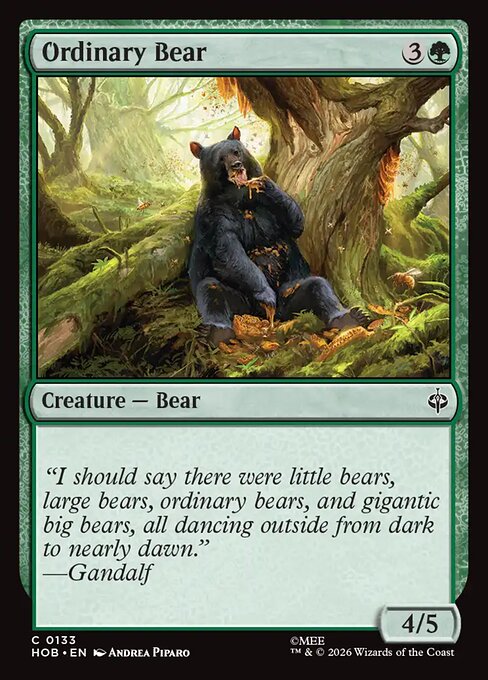
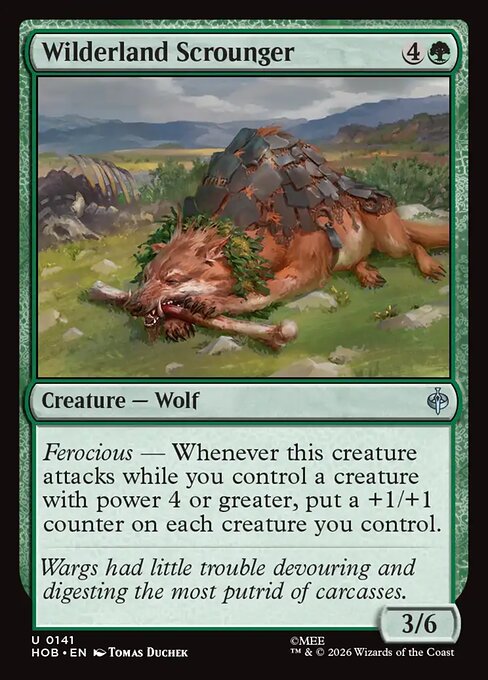
  • Ramping into big green cards that lose. Gigantic Big Bear (52.4%) is only at the deck average although drafters take it around pick 3, and Beorn, Reluctant Host (48.2%) and Wilderland Scrounger (48.9%) are well below it. Your late game is Mirkwood Pathmaker, and counters.

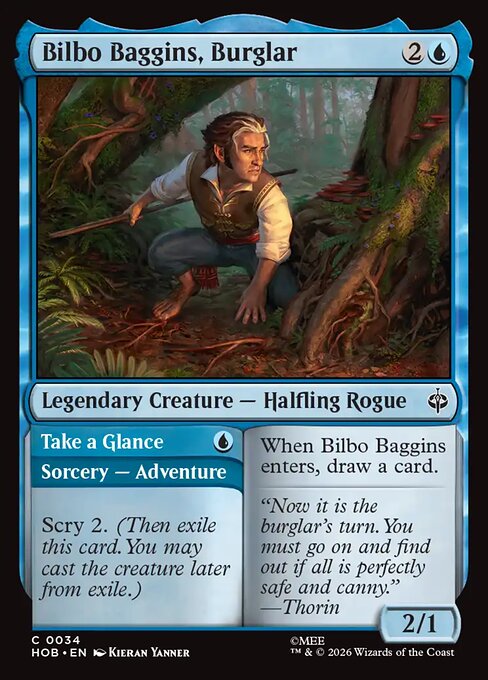
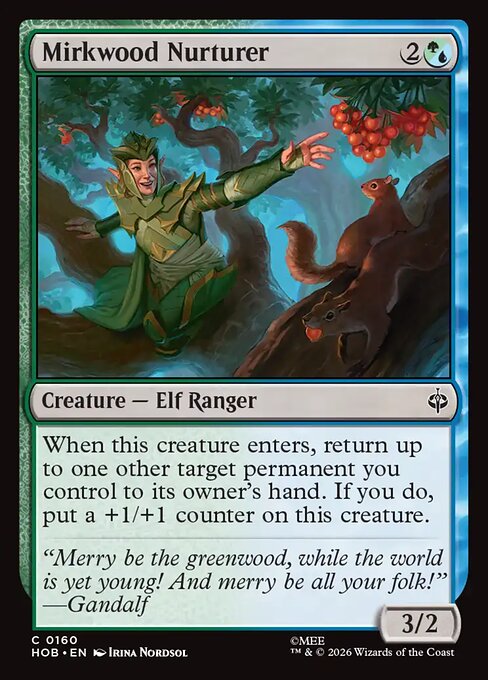
  • a land with Mirkwood Nurturer when you have lands in hand. You get one land drop a turn, so the returned land replaces the new one and you fall a mana behind. Return Wood Elves or Bilbo Baggins, Burglar instead.

  • Counting a second Thranduil, Sindarin Liege or a second copy of the same Bilbo as a full card. They are , so two copies with the same name can't stay on the battlefield together. Bilbo, Luckwearer and Bilbo Baggins, Burglar have different names, so one of each is fine. A second Thranduil is still fine for its Silvan Rally half.

Better or worse in this deck